




Bathing culture
Japan's best onsen towns for travellers with tattoos
Beppu, Kinosaki, Kusatsu, Hakone and more. Japan's most famous onsen towns, what makes each special, and where you can actually bathe with tattoos.
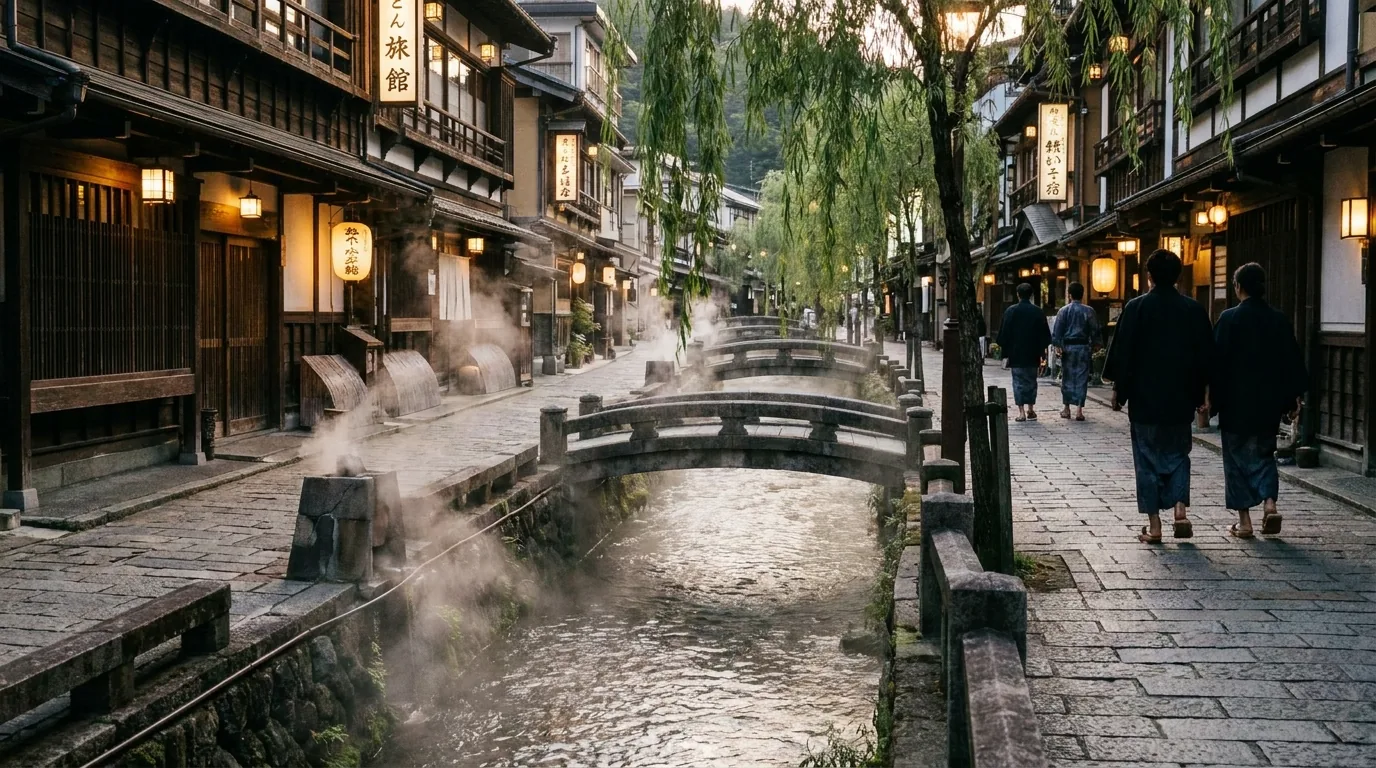
An 温泉街 (onsen-gai), or hot-spring town, is one of the best things you can do in Japan. You walk between bathhouses in a cotton 浴衣 (yukata), eat street snacks steamed in spring vapour and fall asleep in a ryokan. Tattoo rules vary a lot from town to town, though. Some towns have made a point of welcoming everyone. In others, you’ll mostly be relying on private baths and cover patches.
Here are the famous towns worth building a trip around, what makes each one special, and the places from our map where you can bathe with ink.
At a glance
| Town | Prefecture | Known for | Tattoo-friendliness | Our listings |
|---|---|---|---|---|
| Beppu | Oita | Japan’s biggest hot-spring town, eight districts, sand baths | Excellent | 90 |
| Kinosaki | Hyogo | Seven public bathhouses, yukata strolls | Excellent | 6 |
| Kusatsu | Gunma | Strong acidic water, the steaming yubatake | Very good | 4 |
| Yufuin | Oita | Mt Yufu views, boutique ryokan | Good | 7 |
| Hakone | Kanagawa | Close to Tokyo, many districts and spring types | Good (hotel by hotel) | 10 |
| Atami & Ito | Shizuoka | Seaside Izu resorts | Mixed | 6 |
| Ibusuki | Kagoshima | Hot sand baths on the beach | Good | 1 |
| Arima | Hyogo | Gold and silver springs near Kobe | Reported good | 0 |
| Dogo | Ehime | One of Japan’s oldest springs, the 1894 Honkan | Reported good | 3 |
| Gero | Gifu | Silky alkaline water | Cover patches | 3 |
“Our listings” counts the places in each town on our map, including those that allow cover patches or private baths only.
Beppu, Oita: the easiest town in Japan
Beppu has more hot-spring sources and more flowing water than anywhere else in Japan. It’s really eight onsen areas in one, the 別府八湯 (Beppu Hattō), each with its own water, from the sulfur of Myoban to the steam of Kannawa. Between baths, visitors tour the jigoku (“hells”), boiling pools in shades of blue and red.
For tattooed travellers, Beppu is the easy choice. The city’s official tourism site publishes its own tattoo-friendly onsen map, and many of the old neighbourhood bathhouses run by local residents never had a ban. We list 90 places in Beppu, and 57 of them take tattoos with no conditions at all.
- Takegawara Onsen. A grand wooden bathhouse dating back to 1879, with a sand bath.
- Hyotan Onsen. A big day spa in Kannawa with waterfall baths and steam baths.
- Kannawa Mushiyu. An old steam room lined with medicinal herbs.
See all of them on our Oita page.
Kinosaki, Hyogo: seven bathhouses, one policy
Kinosaki is the classic onsen town of old Japan. There’s a willow-lined canal, and guests walk between seven public bathhouses called 外湯 (soto-yu) in yukata and wooden 下駄 (geta). Most ryokan give you a pass for all seven.
According to the town’s official visitor site, all seven soto-yu accept tattoos of any size without covering. That makes Kinosaki one of the best places in Japan to do a full bathhouse crawl. Ryokan set their own rules for their in-house baths, so check before you book.
- Ichinoyu, with its cave bath
- Goshonoyu, the grandest of the seven
- Yanagiyu, a small bath beside the canal
More on our Hyogo page.
Kusatsu, Gunma: strong water, open doors
Kusatsu is one of Japan’s “three famous springs” (日本三名泉, together with Arima and Gero). Its acidic water is strong enough to sting small cuts. The town centre is the 湯畑 (yubatake), a steaming field of wooden channels that cools the spring. Nearby you can watch yumomi, where bathers stir the hot water with long wooden boards to cool it.
The town’s three big day baths say publicly that they don’t turn away tattooed visitors, as long as you follow bath etiquette.
- Sainokawara Rotenburo. A huge open-air bath in a wooded park.
- Otakinoyu. Known for its baths at different temperatures.
- Gozanoyu. Right on the yubatake.
More on our Gunma page.
Yufuin, Oita: the quiet neighbour
A short drive inland from Beppu, Yufuin sits beneath the double peak of Mt Yufu. The morning mist on Lake Kinrin and the small ryokan hidden in rice fields make it feel far more rural. Tattoo rules are set by each ryokan, but Oita’s generally relaxed approach still helps.
- KAI Yufuin. No tattoo rules in the guest-only baths.
- Ryokan Maruya and Ryokan Yamashiroya, both in Yunohira, a small spring village in the same city.
Hakone, Kanagawa: go hotel by hotel
Hakone is the easy weekend trip from Tokyo, with views of Mt Fuji, a lake cruise and a dozen spring areas from Yumoto to Gora and Sengokuhara. There’s no town-wide policy, so you’ll need to choose carefully. Good places do exist.
- Hakone Yuryo. A day spa that dropped its tattoo restrictions in 2025. It also has private open-air baths.
- Gora Hanaougi and Yamanochaya. Ryokan that welcome tattooed guests.
- KAI Hakone.
More on our Kanagawa page.
Atami and Ito, Shizuoka: the Izu coast
Atami is under an hour from Tokyo by shinkansen. Along with its neighbour Ito, it’s an old seaside resort with salty, warming water and ocean views. Many of the big hotels use cover patches, so check the size limits.
- RISONARE Atami. Tattoos OK in the guest-only baths.
- KAI Ito and KAI Anjin. Tattoos OK in the guest-only baths.
The KAI and RISONARE hotels (Hoshino Resorts brands) have no tattoo rules in their guest-only baths. Baths shared with day visitors need cover stickers. See our Shizuoka page.
Ibusuki, Kagoshima: buried in hot sand
At the southern tip of Kyushu, Ibusuki is famous for 砂むし (sunamushi). You lie on the beach in a yukata while staff shovel naturally heated sand over you. Ibusuki Sunamushi Kaikan Saraku accepts tattooed visitors in both the sand bath and the regular bath. See our Kagoshima page.
Arima, Hyogo: gold and silver near Kobe
Arima is another of the three famous springs, tucked into the hills behind Kobe. It’s known for its rust-coloured iron “gold spring” (金泉) and clear “silver spring” (銀泉). Travel guides widely report that the two public baths, Kin no Yu and Gin no Yu, accept tattoos. We haven’t verified them yet, so confirm at the counter. In Kobe itself, the neighbourhood bathhouses Minatogawa-yu and Ashihara Onsen welcome tattoos.
Dogo, Ehime: Japan’s oldest bathhouse town
Dogo, in the city of Matsuyama, is one of the oldest hot springs in Japan. Its wooden main building, the 道後温泉本館, dates from 1894. The city-run public baths are widely reported to accept tattoos. We haven’t confirmed that ourselves yet, so ask at the counter. The places we list here are more restrictive: Dogo Miyu has open-air baths in the rooms, and Ooedo Onsen Monogatari Dogo allows cover patches. See our Ehime page.
Gero, Gifu: plan on cover patches
Gero completes the three famous springs. Its alkaline water is so smooth it’s called a “bath of beauty”. All three places we list here require cover patches: TAOYA Gero, Ooedo Onsen Monogatari Gero Honkan and Gero Bekkan. Small tattoos are fine. For large pieces, look for a room with its own bath. See our Gifu page.
Before you go
- Policies change. A place can relax its rules, or tighten them after one bad experience. Check our listing, then ask at the counter with our phrase cards.
- Ryokan and public baths often have different rules, even in the same town.
- Private baths are your backup. Almost every town has 貸切風呂 (kashikiri-buro), private baths you can book by the hour.
For the reasons behind all this, read why some Japanese baths refuse tattoos.