






Japan travel extras
Go and shogi: Japan's two great board games
Black and white stones on a grid, and pentagonal pieces you can capture and drop back in. A traveller's guide to the history and basic rules of go and shogi, and where to watch or play.
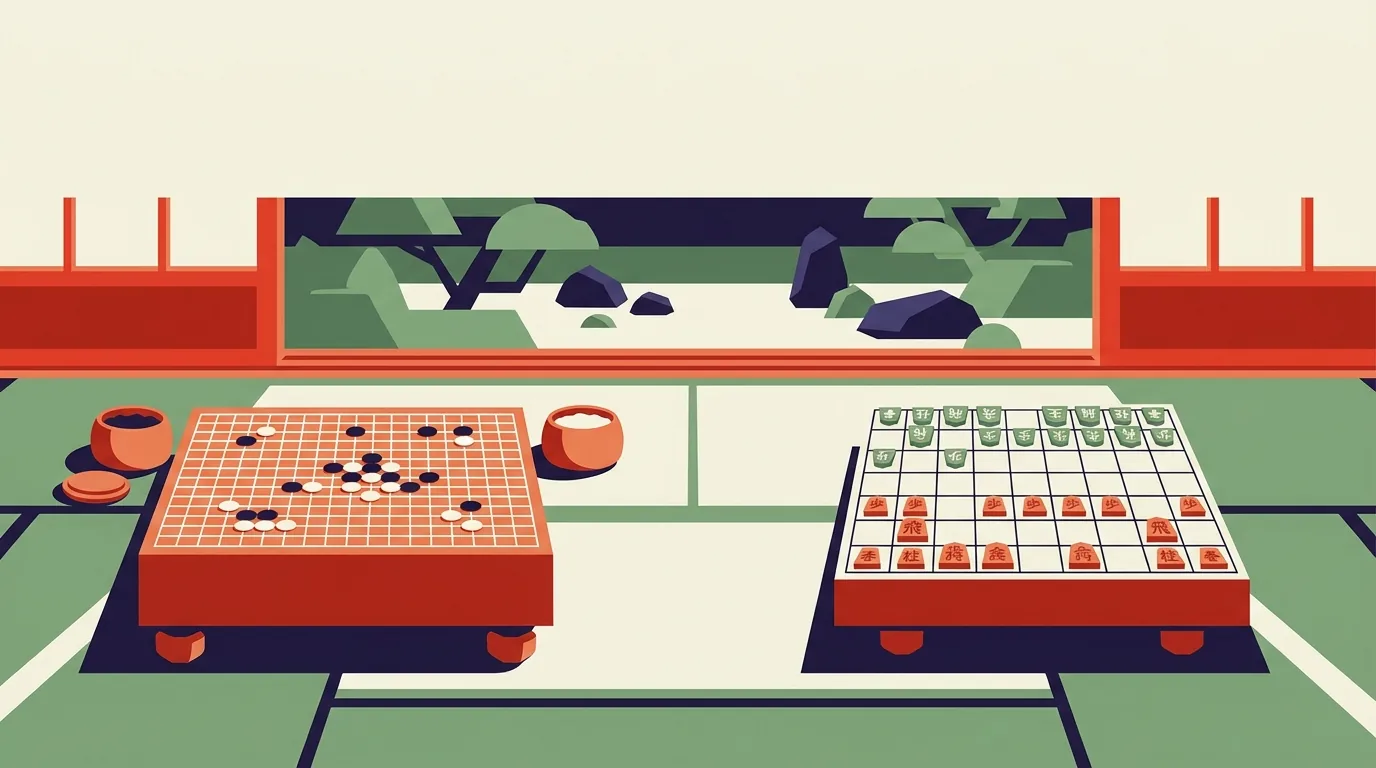
Walk past a community center, a hot-spring lounge or a TV showing a quiet two-hour broadcast, and you may see people bent over a thick wooden board. Japan has two classic strategy games: go (囲碁, igo), played with black and white stones, and shogi (将棋), a cousin of chess. Both have professional players, newspaper-sponsored titles and fans of every age. You don’t need to play well to enjoy them, but knowing the basics makes a match, a museum display or a ryokan board far more interesting.
Go: a short history
Go was born in ancient China and reached Japan by way of the continent well over a thousand years ago. It was already played at court by around the 7th century, and go boards from the 8th century survive in the Shōsōin treasure house in Nara. Court ladies play it in The Tale of Genji.
In the Edo period (1603–1868) the shogunate supported official go houses, the most famous being the Hon’inbō (本因坊) school. Their players competed before the shogun, and the Hon’inbō name lives on today as one of Japan’s top professional titles. Modern Japanese pros belong to the Nihon Ki-in (日本棋院) or the Kansai Ki-in (関西棋院).
Shogi: a short history
Shogi belongs to the same family of games as chess, which is thought to descend from an ancient game in India. How it reached Japan is still debated, but early forms were played by the Heian period, and the modern game on a 9×9 board had taken shape by around the 16th century. Like go, it enjoyed official support in the Edo period, with hereditary families holding the title of Meijin (名人, “master”).
What makes shogi unique is the drop rule: a captured piece switches sides and can be placed back on the board by its captor. Pieces are flat and pentagonal, the same color for both players, and the direction they point shows who owns them. This makes shogi games sharp and full of reversals right to the end.
Today the scene is run by the Japan Shogi Association (日本将棋連盟). Its biggest star is Sota Fujii (藤井聡太), who turned pro as a young teenager and went on to hold all eight major titles at the same time, something no one had done before. His games are national news, and even the lunch he orders during a match makes headlines.
The AI era
Computers now play both games better than any human. In go, AlphaGo’s 2016 win over top professional Lee Sedol stunned the world, and shogi programs passed the best pros around the same time. Instead of killing the games, AI changed how they’re studied. Pros train with engines, and live broadcasts show an evaluation bar so even beginners can follow who’s ahead.
How to play go
Go is played on a grid of 19×19 lines (9×9 and 13×13 boards are used for beginners and quick games).
- Place stones. Black moves first, then players take turns putting one stone on an empty intersection. Stones never move once placed.
- Capture by surrounding. The empty points directly next to a stone or a connected group are its liberties (呼吸点, or dame). When the opponent fills the last liberty, the whole group is captured and removed.
- Make territory. The goal is to surround more empty area than your opponent. At the end, you count the empty points you enclose plus the stones you’ve captured (under Japanese rules).
- Ko (劫). If one stone captures a single stone and the position could just flip back and forth forever, the player who lost the stone must play somewhere else first before taking back.
- Komi (コミ). Because Black has the advantage of moving first, White receives bonus points, usually 6.5 under Japanese rules. The half point prevents ties.
The game ends when both players pass. The rules take five minutes to learn and a lifetime to master.
How to play shogi
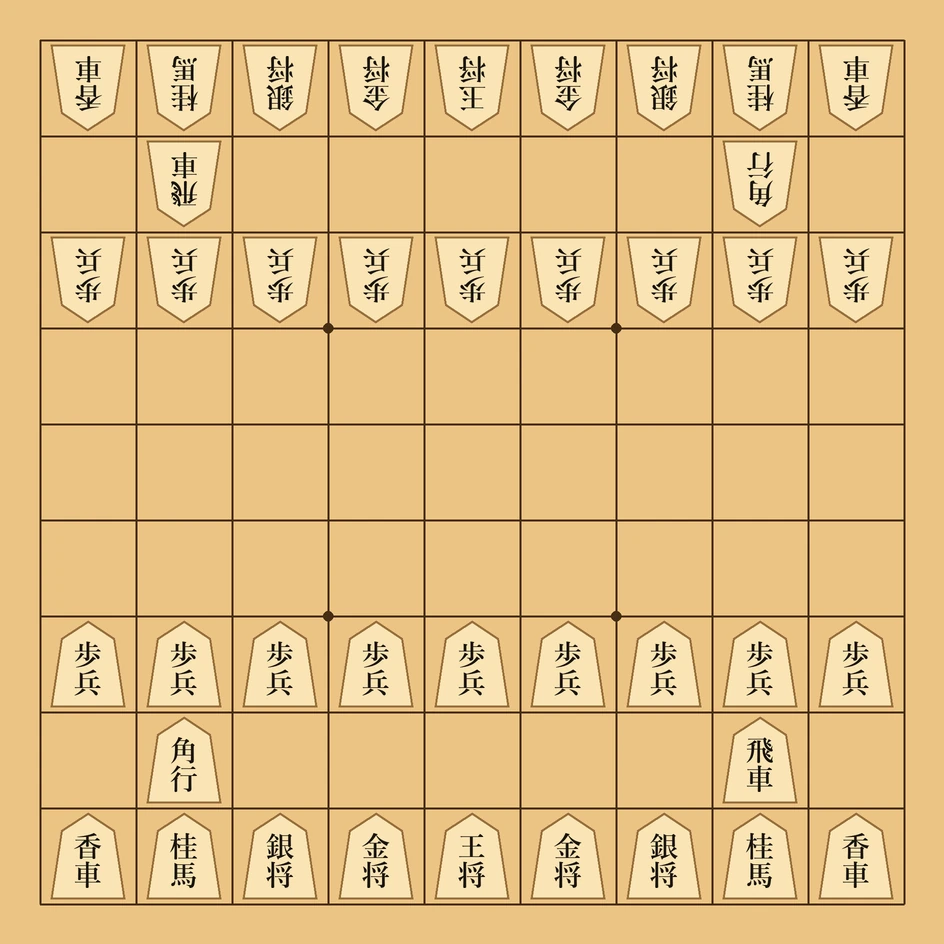
Shogi is played on a 9×9 board, and each player starts with 20 pieces. The goal is to checkmate the opponent’s king. Pieces are marked with kanji, so it helps to learn a few characters.
| Piece | Kanji | Moves | Promotes to |
|---|---|---|---|
| King | 王将 / 玉将 | One square in any direction | — |
| Rook | 飛車 | Any distance straight (forward, back, sideways) | Dragon 龍王: rook + one step diagonally |
| Bishop | 角行 | Any distance diagonally | Horse 龍馬: bishop + one step straight |
| Gold general | 金将 | One square straight or diagonally forward (not diagonally back) | Does not promote |
| Silver general | 銀将 | One square diagonally or straight forward | Moves like a gold |
| Knight | 桂馬 | Jumps two forward and one sideways, forward only | Moves like a gold |
| Lance | 香車 | Any distance straight forward | Moves like a gold |
| Pawn | 歩兵 | One square forward (also captures forward) | Tokin と金: moves like a gold |
Promotion. The last three rows on the opponent’s side are the promotion zone. When a piece moves into, out of or within it, you may flip it over to its promoted side. It’s optional, except when an unpromoted piece could never move again (a pawn or lance on the last row, or a knight on the last two).
Drops. Instead of moving, you can take a piece you’ve captured and place it on any empty square as your own. Dropped pieces always go in unpromoted.
Main forbidden moves:
- Two pawns in one file (二歩, nifu). You can’t have two unpromoted pawns in the same column. Even pros occasionally lose this way.
- Pawn-drop mate (打ち歩詰め, uchifuzume). You can’t checkmate by dropping a pawn. Mating with a pawn that moves there is fine.
- Dead pieces. You can’t drop a piece where it could never move, like a pawn on the last row.
- Endless repetition (千日手, sennichite). If the same position repeats four times, the game is replayed from the start with colors swapped. The exception is perpetual check: the side giving check every move loses.
- Taking a move back (待った, matta). Not a rule in casual games, but asking to undo a move is bad form. Once your hand leaves the piece, the move stands.
Where to see or play as a traveller
- Nihon Ki-in, Tokyo. The go association’s headquarters is in Ichigaya. It hosts professional games and has playing space for amateurs. Check the official website for current hours and any English-language events.
- Kansai Ki-in, Osaka. The go association for western Japan, also a base for pro and amateur play.
- Shogi Kaikan, Tokyo. The Japan Shogi Association’s home in Sendagaya, with a public shogi dojo and a shop selling boards, pieces and fans signed by pros.
- Go and shogi salons. Across Japan you’ll find small 碁会所 (gokaisho, go salons) and 将棋道場 (shogi dōjō). You pay an entry fee and staff pair you with someone of similar strength. Few staff speak English, but a board needs little translation. Saying you’re a beginner (初心者です, shoshinsha desu) goes a long way.
- Online. Sites and apps like OGS or KGS for go, and 81Dojo or Lishogi for shogi, have English interfaces and are a good way to practice before a trip.
- Onsen ryokan. Big title matches are traditionally held over two days at famous hot-spring inns and hotels, and some ryokan proudly display the boards used. Many ryokan lounges also keep a go or shogi set for guests. Ask at the front desk and spend a quiet evening in your yukata over a game.
Board-side manners
Both games open and close with a bow. The phrases are short and worth learning:
| When | Say | Meaning |
|---|---|---|
| Before the game | お願いします (onegai shimasu) | “Please, let’s play” |
| When you resign | 参りました (mairimashita) | “I’m beaten” |
| After the game | ありがとうございました (arigatō gozaimashita) | “Thank you for the game” |
- Resigning is the normal way to end. When the game is clearly lost, bow slightly and say 参りました. Playing on to the last move in a hopeless position is considered less graceful than resigning, and a clean resignation earns respect.
- After the game, players often replay it together to discuss it (感想戦, kansōsen). If your opponent offers, it’s the best free lesson you’ll get.
- Watch silently at clubs, and don’t point at the board or comment on someone else’s game.